My Journey from Data Engineering to AI Innovation

From a village without Television to Global Recognition.
Krishnam Nimmala's journey began in a rural Indian village, raised by parents whose formal education never reached fifth grade. Through determination, part-time tutoring, and an unshakeable belief in education's power, he built an extraordinary career in technology. Today, Krishnam serves as an Informatica MDM Engineer at Ford Motor Company, bringing enterprise-grade data leadership to one of the world's most iconic organizations. A Senior Member of IEEE, ACM Peer Review Certified, and recipient of both the Bronze Globee® AI Award 2026 and the Global Recognition Award 2026, he is internationally recognized for innovation that matters.
He founded "Eyevo" an AI-powered smartphone vision screening tool built for rural communities and school children without access to eye care. He is also the published author of "The Quiet Battle Inside" — an inspirational novel for teenagers.
My Identity
Get to know my personality and passions.
My Passions
Explore my favorite hobbies and interests.
EYEVO: INNOVATION
One Smartphone. Zero Hardware. Infinite Impact.
One Smartphone. Zero Hardware. Infinite Impact.
One Smartphone. Zero Hardware. Infinite Impact.
EYEVO is Designed to improve access to early vision screening, uses a mobile, intelligent, and scalable approach to help identify vision acuity issues sooner and support timely intervention for students and underserved communities. The platform combines software innovation with practical healthcare impact, reflecting the value of AI-enabled tools in expanding screening reach. EYEVO architecture featured in IEEE news publication, and built by Krishnam Nimmala,
Eyevo represents a fundamental rethinking of how vision care can be delivered, particularly to the 2.2 billion people worldwide living with unaddressed vision impairment, the majority of whom reside in low-income and rural communities with little or no access to eye care professionals.
How Eyevo Works
One Smartphone. Zero Hardware. Infinite Impact.
One Smartphone. Zero Hardware. Infinite Impact.
EYEVO using advanced Artificial Intelligence and smartphone camera technology, Eyevo performs vision screening assessments comparable to clinical evaluations, directly on any standard smartphone, with no additional hardware required.
Currently in active Beta Testing, Eyevo's results are
being rigorously compared against clinical outcomes to
validate accuracy and reliability, a critical step toward
global deployment and regulatory compliance.
<<< add about architecture highlevel like no hardware, results stored on device etc....
Eyevo: Real World Impact
One Smartphone. Zero Hardware. Infinite Impact.
THE PROBLEM EYEVO SOLVES:
Eyevo has already moved beyond the BETA. Demonstrated live at IEEE-affiliated STEM outreach events at local schools,
Eyevo has introduced AI-powered vision screening directly to students and educators, bringing cutting-edge healthcare technology into classrooms where it is needed most.
These real-world demonstrations have validated Eyevo's accessibility, ease of use, and transformative potential for communities that traditional healthcare systems have long overlooked.
THE PROBLEM EYEVO SOLVES:
EYEVO: Recognition & Intellectual Property
THE PROBLEM EYEVO SOLVES:
Across the world, millions of school-going children and families in underserved communities suffer from undiagnosed vision impairments. Without access to eye care clinics or professionals, these conditions go undetected — silently affecting learning, development, and quality of life.
In rural India, rural America, and low-income communities globally, the
Barriers are the same:
- No local eye care professionals
- No affordable screening equipment
- No awareness of existing vision problems
Eyevo eliminates all three barriers — instantly.
EYEVO: Recognition & Intellectual Property
EYEVO: Recognition & Intellectual Property
EYEVO: Recognition & Intellectual Property
✦ Bronze Globee® AI Award 2026
Most Innovative AI Person of the Year
✦ Global Recognition Award 2026
Honored for AI Innovation & Humanitarian Impact
✦ Patent Pending
Proprietary AI vision screening methodology
✦ IEEE STEM Outreach
Demonstrated at local school events
✦ Active Beta Testing
Clinical comparison,validation underway
Global Vision
EYEVO: Recognition & Intellectual Property
EYEVO: Recognition & Intellectual Property
Eyevo is not just a product. It is a movement.
A movement to ensure that a child in a rural village just like Krishnam Nimmala himself grew up in never has to struggle through school with an undetected
vision problem simply because an eye doctor was not available nearby.
Eyevo exists to close the gap between innovation and humanity.
add event gallery

write about real world participation events....
Credentials: IEEE · ACM · Ford
SMIEEE · ACM Peer Review Certified · MDM Engineer at Ford Motor Company
PUBLISHED AUTHOR
"THE QUIET BATTLE INSIDE"
AI and Machine Learning Advances
"THE QUIET BATTLE INSIDE"

In a world filled with constant noise, comparison, and digital overload, many teens fight a quiet
battle—struggling to stay focused, understand themselves, and find meaning in their everyday lives.
“THE QUIET BATTLE INSIDE” explores that struggle through six unique journeys.
Six individuals.
Six forms of distraction.
Six paths toward self-understanding.
Each section of this book centers on a different character and theme, reflecting the real challenges
teens face today—overthinking, self-doubt, fear of failure, emotional isolation, digital distraction,
and loss of direction. Through reflective storytelling, practical insights, and thoughtful guidance,
readers are encouraged to slow down, look inward, and build inner strength.
Rather than offering quick fixes, this guide helps teens develop awareness, resilience, and
purpose—skills that matter long after the noise fades.
Available in all major Online Platforms across globe including Barnes & Noble, Amazon, Walmart, target, Apple book with Physical, Digital and audio versions.
Product details
- ASIN : B0GPS792DD
- Publisher : Spines
- Publication date : February 23, 2026
- Language : English
- File size : 1.6 MB
- Screen Reader : Supported
- ISBN-13 : 979-8902233169
- Page Flip : Enabled
- Best Sellers Rank: #104,743 in Teen & Young Adult Literature & Fiction

AI and Machine Learning Advances
AI and Machine Learning Advances
AI and Machine Learning Advances

Title: Evaluating the Evolution and Efficacy of AI-Driven Intrusion Detection Systems Against Zero-Day Attacks
1*Krishnam Nimmala
1 Information Technology/software engineering, Independent Researcher
Received: 11-Feb-2026 | Revised: 25-Feb-2026 | Accepted: 08-Mar-2026
Doi
https://doi.org/10.64220/amla.v2i1.006
Abstract
There is a high rate of cyber threats development and the use of the zero-day attack, which presents a great challenge to the conventional intrusion detection system (IDS). This paper compares the performance and the generalization ability of the AI-based IDS models on two benchmark datasets (NSL-KDD (legacy) and CIC-IDS2017 (modern)) datasets. We present comparisons of Random Forest, XGBoost, and Support Vector Machine in supervised and zero-day simulation scenarios in a leave-one-attack-out set up. Supervised performance has been observed to be almost perfect on both datasets, with recall and ROC-AUC scores being close to 0.999 with the tree-based models. Nevertheless, zero-day analysis demonstrates significant performance reduction, and a drop to about 68 and 58 percent on NSL-KDD and CIC-IDS2017, respectively. These results demonstrate that there is a severe disparity between controlled precision and actual generalization in the real world. The findings show that AI-based IDS models are effective in detecting known attacks but have poor zero-day resiliency, and it is important to note that more generalized and adaptable intrusion detection systems should be designed.
Recognition That Reflects a Mission Not Just an Achievement

🏆 Bronze Globee® Award for Artificial Intelligence 2026
Category: Most Innovative AI Person of the Year
Presented by: Globee® Awards for Artificial Intelligence
Year: 2026
About this Award:
The Globee® Awards are among the world's most prestigious technology and business recognition programs, honoring
outstanding achievement in artificial intelligence and innovation across the globe. Being named Most Innovative AI
Person of the Year places Krishnam among the world's most distinguished AI innovators recognized for pioneering
Eyevo, an AI-powered smartphone vision screening platform that is transforming healthcare access for underserved
communities worldwide.
"This recognition validates not just the technology but the mission behind it."

🏆 Global Recognition Award 2026
Category: AI Innovation & Humanitarian Impact
Year: 2026
About this Award:
The Global Recognition Award honors individuals who
demonstrate outstanding achievement and meaningful
contribution to their field at an international level.
Krishnam Nimmala was honored for his pioneering work
with Eyevo — an AI innovation that addresses one of
the world's most critical healthcare gaps, bringing
vision screening to rural communities and low-income
families across the globe who lack access to eye
care professionals.
Education
Education
I have a Bachelor's degree in Computer Science from XYZ University. During my time there, I gained a strong foundation in programming, data structures, algorithms, and computer architecture.
MEDIA PUBLICATIONS (PRESS & RESEARCH)
Internationally Honored for Excellence in AI Innovation & Humanitarian Impact
Internationally Honored for Excellence in AI Innovation & Humanitarian Impact
Internationally Honored for Excellence in AI Innovation & Humanitarian Impact

Krishnam Nimmala's innovations have earned attention from respected media outlets and distinguished professional organizations worldwide independently validating the significance and real-world impact of his work in artificial intelligence, healthcare innovation, and inspirational authorship.
IEEE Region 3 news article: News Letter Volume 41 - No.1 - IEEE Region 3
https://r3.ieee.org/2026/03/25/newsletter-volume-41-no-1/
Title: EYEVO - Software-Centric Mobile Vision Screening Using Adaptive On-Device Architecture
Page No: 36 & 37
Featured in The AI Journal: AI Should Be Judged by Whether People Can Trust It
Internationally Honored for Excellence in AI Innovation & Humanitarian Impact
Internationally Honored for Excellence in AI Innovation & Humanitarian Impact
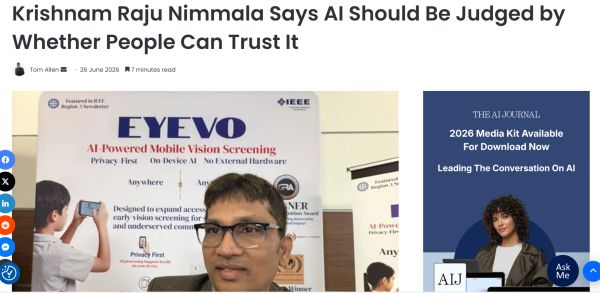
Published: June 26, 2026 | By: Tom Allen, Founder & Director, The AI Journal | Category: AI & Technology | 8-minute read
The AI Journal — a leading AI trade publication whose Founder and Director personally wrote this feature — published a full thought leadership piece on responsible AI development, using my work with EyeVo and my career at Ford Motor Company as the lens through which the argument is made.
The article opens with a challenge to the AI industry that sits at the heart of everything I build:
“Stop building AI for applause. Start building it for the people who need it most.”
Tom Allen — the publication’s founder — frames the piece around a question the AI industry too rarely asks: what happens after the demo? Can the system actually be trusted? Can real people use it without perfect conditions or specialist support? Can it protect sensitive data and operate reliably in the settings where it will actually be deployed?
The feature covers five key dimensions of my work and perspective:
• What the engineering community has already recognized — IEEE Region 3 Newsletter Vol. 41 featuring EyeVo’s ISO 8596-aligned architecture, and the IEEE Computer Society independently highlighting EyeVo as an “Innovative AI Activity” on their official LinkedIn
• Trust as a design requirement, not an afterthought — why ethics, privacy, cybersecurity, and data governance must be built into the foundation of healthcare AI, not added later
• The data governance connection — how two decades at Ford Motor Company, Wells Fargo, CooperVision, and Tech Mahindra shaped EyeVo’s privacy-first, local-only data architecture
• Tested where it matters most — real-world demonstrations at Family STEM Night, Sedalia Park Elementary, Harmony Youth Center, East Cobb Library, and IEEE IWRC Dayton, with a named witness quote from event coordinator Melody Richardson
• A standard the industry needs to adopt — the argument that AI must be judged not by performance benchmarks alone but by whether it deserves the trust of the people it will affect
The article also features the independent quote from Alex Sterling, spokesperson for Global Recognition Awards, and documents the 2026 Global Recognition Award (top 5.8% of 15,000 applicants, perfect scores across all five innovation subcategories) and the Globee Most Innovative AI Person of the Year 2026 Award.
“Responsible AI is not something you attach later. If the work touches healthcare, trust has to be built into the foundation.”
That The AI Journal’s own founder chose to write this piece personally — rather than assign it to a staff writer — signals that the argument resonated at the highest editorial level. The publication describes itself as “Leading The Conversation On AI” and serves an audience of AI executives, researchers, and technology leaders worldwide.
“The most important question any AI leader can ask right now is not whether their system performs well. It is whether their system deserves to be trusted by the people it will affect. Those are not the same question.”
Featured in Distractify: From Rural India to International Recognition
Featured in Analytics Insight: Turning Smartphones Into AI Vision Screening Tools
Featured in Analytics Insight: Turning Smartphones Into AI Vision Screening Tools

Published: July 20, 2026 | By: Reese Watson, Distractify
Distractify — one of the world’s largest general interest digital platforms with over 8 million monthly readers — published a full feature story on my journey from a rural Indian village to international recognition in artificial intelligence and healthcare innovation.
The article traces how growing up without access to healthcare or technology became the driving force behind everything I have built. My parents’ formal education ended at fifth grade. I worked as a part-time tutor to fund my own education. Those early experiences never left me — and they are the reason EyeVo exists today.
“I did not find my inspiration in a boardroom. I found it by seeing what happens when people have potential but not access.”
The story covers EyeVo’s mission to bring AI-powered vision screening to underserved communities using nothing but a smartphone — no external hardware, no clinic required. It highlights the platform’s real-world demonstrations across schools, community centers, and the IEEE IWRC conference in Dayton, Ohio, and documents independent recognition from:
• 2026 Global Recognition Award — top 5.8% of 15,000 applicants, perfect scores across all five innovation subcategories
• IEEE Region 3 Newsletter, Volume 41, Spring 2026 — featured on pages 36–37
• IEEE Computer Society — independently featured EyeVo as an “Innovative AI Activity” on official LinkedIn
• Globee Most Innovative AI Person of the Year 2026 Award
The feature also touches on my novel The Quiet Battle Inside — and the common thread that runs through all of my work: building things that reach the people who need them most.
Featured in Analytics Insight: Turning Smartphones Into AI Vision Screening Tools
Featured in Analytics Insight: Turning Smartphones Into AI Vision Screening Tools
Featured in Analytics Insight: Turning Smartphones Into AI Vision Screening Tools

Published: July 27, 2026 | By: Arundhati Kumar, Analytics Insight | Category: Artificial Intelligence
Analytics Insight — one of the world’s leading AI and data science trade publications with 2–3 million monthly readers — published a full feature on EyeVo and its mission to make vision screening accessible to underserved communities through smartphone-based AI.
The article opens with a question that drives everything I build: how can a person have a vision problem for years before anyone catches it? The answer, more often than not, is access. Screening tools exist. Specialists exist. But they do not always reach the communities that need them most. EyeVo was built to close that gap — using devices people already have, in places where traditional healthcare infrastructure may not reach.
“I am not interested in AI that only looks impressive in a controlled setting. The harder question is whether it can work in the real world, where conditions are imperfect and people still need help.”
Analytics Insight covered four key dimensions of EyeVo’s development and recognition:
• The engineering problem EyeVo solves — replacing specialized clinical hardware with adaptive smartphone-based on-device AI, built on ISO 8596-aligned screening methodology
• Real-world validation across six U.S. states — 350+ screening sessions, five STEM outreach events including Family STEM Night, Sedalia Park Elementary, Harmony Youth Center, East Cobb Library, and IEEE IWRC Dayton
• Enterprise data discipline — how two decades at Ford Motor Company, Wells Fargo, CooperVision and Tech Mahindra shaped EyeVo’s privacy-first, local-only data architecture
• Independent recognition from the 2026 Global Recognition Award (top 5.8% of 15,000 applicants, perfect scores across all five innovation subcategories), IEEE Region 3 Newsletter Vol. 41, IEEE Computer Society LinkedIn, and the Globee Most Innovative AI Person of the Year 2026 Award
The article also features the independent quote from Alex Sterling, spokesperson for Global Recognition Awards: